




23 February, 2026

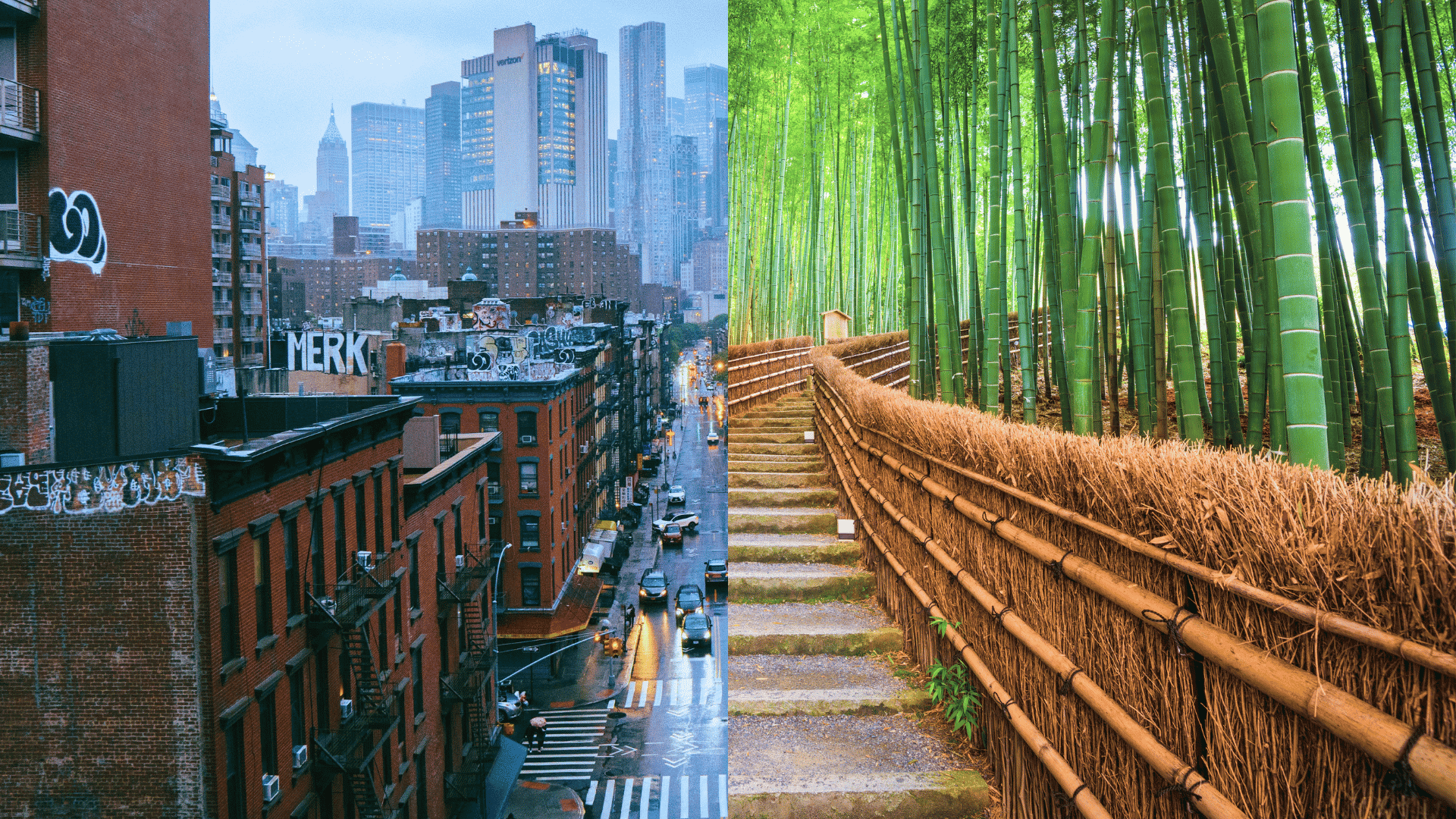
Moving to Japan is becoming a dream for more and more Americans each year, but setting aside all the hype, how realistic is it to move to Japan as an American in 2026? The good news is it’s certainly possible, but turning that dream into reality isn’t all sushi and rainbows!
Having all made the move from the US to Japan ourselves, the team at Japan Remotely knows firsthand what it takes to successfully make the transition and thrive after arriving. In this guide, we’ll go point by point and break down everything you need to know if you’re serious about how to move to Japan from the USA.
It’s one thing to have a dream of living in Japan; it’s another to have legal permission to live here. Before anything else, consider what it is you intend to do while living in Japan. Do you plan to study? Work? Run a business? All of these are possibilities, but each requires the appropriate visa. It’s easy for Americans to visit Japan, but to live there, you will need a visa. Below, we’ll go over some of the most common pathways.
One of the most reliable options to start your life in Japan is as a student. This includes attending a Japanese language school all the way up to studying for your bachelor’s, master’s, or Ph.D at a university. There are even schools with complete English-language tracks, as we’ve detailed here.
The pros of taking this route are that you can acclimate to Japanese culture while you’re a student, soaking in the customs, language, and networking before entering the workforce. It’s also generally much easier to change visas once you’re in Japan than to obtain a working visa from outside the country. Additionally, graduating with a degree from a Japanese university (not a language school) can be beneficial later when applying for permanent residency or some work visas.
The biggest con for most people is going to be time and money. Tuition in Japan isn’t nearly as expensive as in the US, but it’s still going to run you at least a few thousand dollars per year. You’re also limited to how much you can work on a student visa, which may make it tough for those who don’t have significant savings or someone else supporting them. You also need to actually attend the classes (at least 80% or more) to keep your student visa, so this isn’t an option for people who are interested in learning casually.
Obtaining a student visa generally isn’t that difficult, although it’s one of the targets of recently heightened regulations. In general, step 1 is to get accepted by the school. Once that happens, your school will give you the necessary documents to apply for the visa at your local consulate. For a more detailed breakdown of what that might look like, check out our article here. Interested in language school? There is free placement and admission counseling via KOKO JAPAN.
Not interested in being a student? Then the working life might need to be for you, my friend! Japanese employers generally prefer hiring those who are already based in Japan, but that doesn’t mean getting hired from outside the country is impossible.
English teaching is the most traditional route taken by Americans, as it only requires you to have a bachelor’s degree. The JET Program is the most sought-after due to the salary and support they give their teachers, but it’s also the most competitive for that reason. You also cannot select where you’re placed, so if the idea of living in some far-off village in the countryside doesn’t appeal to you, consider that carefully before applying.
There are many American sister city relationships that are considered when JET location assignments are determined. You may be interested to look up if your area has a sister city. If you land JET, this could be your next stop!
On the other hand, you can also try to work as a language teacher at a private institute, known as an Eikaiwa. These generally have lower pay and higher workloads than JET, and many Eikaiwa have poor reputations, so take this as a word of warning to do your research. That said, not all Eikaiwa jobs are terrible, and many are located in major cities, with opportunities to teach adults instead of children, if those are important considerations for you. (For even more options on teaching in Japan, check out our previous article here.)
What about a regular office job? The biggest question is what skills do you bring to the table that would warrant a Japanese company hiring you from abroad? International transfers are not unheard of, but are usually reserved for more experienced workers and/or those in highly specialized fields. For example, IT is an industry with a high demand for international talent. There are specialized job hunting boards geared towards tech jobs for English-speaking foreigners in Japan, like tokyodev.com. Check out an extensive list of job boards and resources on our full “How to Move to Japan” article.
For those without specialized skills and/or in high-demand industries, your options become more limited, but that doesn’t mean working in Japan is impossible; it just means that you may need to build yourself a roadmap of how to get your dream position.
For example, if you work in marketing and want to make the leap to Japan, it might be easier to work in that industry for a few years in the US, save up some money, and then make the move to Japan as an English teacher or student. Then you could apply for marketing jobs once you’re already in Japan and have honed your language skills, rather than trying to get hired directly from overseas. Plus, you’d already have some experience on your resume vs. applying directly after graduation. In non-engineering roles, it really helps your chances if you have advanced Japanese language skills. In general, JLPT N2 or equivalent is needed.
Most “white collar” professions (IT, marketing, finance, etc.) are going to fall under the “Engineer/specialist in humanities/international services” visa, although there are more specialized visas, such as artist or journalism visas, provided you have the appropriate skills and experience. For the most part, once you are hired by a local company, they will provide you with the paperwork to take to the immigration office, but the exact process will vary depending on the circumstances.
If working for a Japanese company sounds more like a nightmare than a dream to you, you might be thinking that starting your own business is a better idea. Well, while it certainly comes with its benefits over working for someone else, running a business can be a whole other nightmare if you aren’t ready for it.
The Business Manager Visa was formerly the most popular option, but due to changes in 2025 that dramatically raised capital requirements, it’s no longer an accessible route for most people. Other options include the Startup Visa, which allows for a stay of up to two years to prepare a business that would meet the qualifications of the Business Manager Visa. A less common but viable option is to use what’s known as an Employer of Record, in which your company works with a local Japanese enterprise to bring you on as a local employee.
*Note for Americans: While Japan’s immigration system treats most nationalities similarly for these visa types, Americans benefit from the US-Japan Treaty of Friendship, Commerce, and Navigation, which provides certain protections for American business interests in Japan. Reach out if you’re planning a business venture and would like to learn about your options.
Alright, alright, I hear you – you don’t want to do any of the above! If you’re someone looking to work as a freelancer, one route could be self-sponsorship. To be clear, there is no visa called “The Self Sponsorship Visa.” Rather, self-sponsorship is a strategy that would allow you to live in Japan on a normal working visa (primarily the “Engineer/specialist in humanities/international services”) while providing services to multiple clients.
The key here is that one of your clients must act as your visa sponsor, and that your total income across your various contracts must be sufficient to support yourself (there’s no exact threshold, but about 2 million yen is generally considered the minimum). Since you’d be working as a contractor, all health insurance, pension, and tax burdens would also fall on you.
So, for example, if you work as a freelance translator for three companies, but only one of them is able to serve as your visa sponsor, you’d present that company’s sponsorship documents along with your other contracts and proof of income to the immigration office when applying for or renewing your visa.
If the activities fall outside the scope of your original purpose of stay (say you decide to work as a freelance web designer on the side), then you’d also need to submit the (very long-named) “Application for permission to engage in an activity other than those permitted by the status of residence” form as well.
| Visa Type | Best For | Duration | Key Requirement |
|---|---|---|---|
| Student Visa | Language students, university students | Duration of study | Job offer from a Japanese employer, bachelor’s degree or relevant experience, JLPT N2 in many cases |
| Engineer/Specialist (Work) | IT, finance, marketing, white-collar roles | 1–5 years, renewable | Job offer from Japanese employer, bachelor’s degree or relevant experience, JLPT N2 in many cases |
| Instructor/Humanities (Work) | English teachers, Eikaiwa staff | 1–5 years, renewable | Job offer; bachelor’s degree (any field) |
| Business Manager | Starting a Japanese company | 1 year, renewable | ¥30 million capital, Japanese language, and many other conditions |
| Startup Visa | Launching a reliable business | Up to 2 years | Approval from the government in anticipation of meeting later Business Manager Visa requirements |
| Highly Skilled Professional (HSP) | Experienced professionals | 5 years | 70+ points on Japan’s point-based system. Need to have a job offer or to start a business. |
| Spouse/Dependent | Spouses of Japanese nationals or PR holders | 1–3 years, renewable | Marriage certificate or proof of dependent status |
Okay, so you’ve decided how you’re going to move to Japan, the next question is where you want to be and how you’re going to afford it. Depending on which source you look at, the cost of living in Japan is roughly 30 to 50% lower than in the US. While that might sound incredible, keep in mind that local Japanese salaries reflect this difference. If you’re earning in Yen, your spending power will be greatly reduced.
Also consider where you might be living. Just like in the US, the cost of living in Japan can vary widely depending on which part of the country you reside. A one-bedroom apartment in Tokyo is going to be far more expensive than one in a smaller regional city like Sapporo or Fukuoka, and the countryside will be even cheaper still.
For Americans coming from major hubs like New York, San Francisco, or Chicago, the cost of living in Tokyo will be significantly cheaper. Rent, for example, is about half as expensive as it would be in San Francisco, while essentials like food, clothing, transportation, healthcare, and utilities are also cheaper. Again, though, make sure to research local salaries for the industry you plan to work in and see how they fit into your cost-of-living plan.
If you can make it work in another city besides Tokyo, your costs can be even lower!
| Expense | Tokyo (Monthly Est.) | New York City | San Francisco | Chicago |
|---|---|---|---|---|
| 1-BR Apartment (city center) | ¥120,000–¥180,000 (~$800–$1,200) | ~$3,500–$4,500 | ~$3,200–$4,500 | ~$1,800–$2,500 |
| Groceries | ¥30,000–¥45,000 (~$200–$300) | ~$400–$500 | ~$450–$550 | ~$350–$450 |
| Public Transit (monthly pass) | ¥10,000–¥15,000 (~$65–$100) | ~$130 | ~$100 | ~$105 |
| Utilities | ¥10,000–¥15,000 (~$65–$100) | ~$150–$200 | ~$150–$200 | ~$150–$200 |
| Health Insurance (public) | ¥10,000–¥30,000 (~$65–$200) | ~$300–$600+ | ~$300–$600+ | ~$300–$600+ |
| Eating out (mid-range meal) | ¥1,000–¥1,500 (~$7–$10) | ~$20–$30 | ~$20–$35 | ~$15–$25 |
Note: Exchange rates fluctuate. Figures based on approximately ¥150 to $1 USD.
*A Note on Banking and Money Transfers for Americans
Moving your money to Japan as an American comes with some unique considerations. Wire transfers from US banks can be slow and expensive. Services like Wise are popular among American expats for moving money internationally at favorable exchange rates. Once in Japan, opening a Japanese bank account (Japan Post Bank is usually an expat-friendly option) is highly recommended for day-to-day expenses.
Also, be aware that as an American citizen, you are subject to US tax obligations no matter where in the world you live. More on that in the paperwork section below.
Which locations are most convenient for Americans? While you may be thinking you want to escape other Americans if you’re moving to another country, keep in mind that unless you’re fluent in Japanese, your quality of life may be significantly impacted by how foreigner-friendly your area is. And besides, you’ll quickly realize how helpful it is to have people who speak the same language, navigate culture shock, and share the same experiences as you while navigating life in a completely different culture.
As an international hub, Tokyo hosts the majority of the foreign population in Japan. Some of the most popular expat neighborhoods are the central districts of Meguro, Minato, and Shibuya, offering a mix of vibrant city life and convenience (for central city prices) as well as [modest] support for English-speakers at places like city hall and health clinics.
For something more affordable without sacrificing urban convenience, look outside the main downtown to places like Chiba, Saitama, or Yokohama. They offer many of the same amenities at a fraction of the cost, while still being only a train ride away from the heart of Tokyo.
For Americans who need to travel back to the US frequently, Tokyo is the clear winner: both Narita and Haneda airports offer direct flights to many major US cities, including Los Angeles, New York, Chicago, and San Francisco.
Osaka is Japan’s second-largest metropolitan area and a fantastic city in its own right, known for its food culture, nightlife, and slightly more laid-back atmosphere compared to Tokyo. The Kansai region also includes Kyoto and Kobe, offering expats a wide range of neighborhoods and lifestyles. Osaka offers some direct flights to West Coast US cities like Los Angeles and San Francisco, but for most Americans, especially those on the East Coast or Midwest, a connection will be required.
Cities like Fukuoka, Nagoya, Sapporo, and Hiroshima are increasingly popular with younger expats for their lower costs and growing international communities, though English support and foreign-community infrastructure are less developed than in Tokyo or Osaka.
Base-adjacent areas will naturally have a higher-than-average proportion of Americans and services catering to them. This, of course, includes Okinawa, as well as the bases at Yokota, Yokosuka, Atsugi, and Iwakuni, among others.
Many people romanticize life in the Japanese countryside, and it can be genuinely beautiful and rewarding. However, the language and cultural barriers in rural Japan are real and should not be underestimated. Unless you’re fluent in Japanese or going as part of a program like JET (which provides some built-in support), rural life can become isolating. That said, some rural municipalities are actively recruiting residents (including foreigners), even offering incentives like subsidized housing in some cases.
So you’ve decided what you’ll be doing in Japan and where you might want to be located, but what concrete steps do you need to take to actually find work or schooling?
If you’re coming as a language student, the good news is that there is no shortage of options. The bad news is that finding just the right school that fits your learning style and needs thus becomes more difficult. You’ll also need to check to ensure that the school you’re interested in can actually sponsor a student visa, as not all schools are set up for that. Thankfully, we have a detailed list of schools that can sponsor visas here, including their location and costs.
Getting your degree in Japan is an exciting prospect, but your foremost concern should be your course of study and the quality of the education you’ll receive. If you don’t know where to start, we’ve put together a list of English-language programs here, covering a wide range of studies from International Relations and Business to Arts and Sciences. Note that a degree from a Japanese university (as opposed to a language school) can strengthen a future application for permanent residency.
For Americans who want to experience Japan before fully committing, a study abroad program through a US-based university is an excellent option. Many American universities have exchange partnerships with Japanese institutions, allowing you to spend a semester or year in Japan while maintaining your enrollment at home. This is a lower-stakes way to test the waters before making a permanent move.
Some multinational companies offer internal transfer programs to Japan. For example, the architecture and design firm, Gensler, has offered year-long placements in their Tokyo offices. If you work for a large company with a Japanese presence, it’s worth asking HR whether such opportunities exist. This route has the advantage of visa sponsorship handled by your employer, making the logistics considerably simpler.
For Americans looking to enter the Japanese workforce directly from the US, here are the most practical avenues:
Keep in mind that Japanese companies often have hiring cycles tied to the fiscal year (April start), so timing your applications accordingly can matter.
There are actually a lot of creative career options. Check out Alternative Japan Career Ideas (That Are Actually Exciting) for more ideas.
Once your visa and work or study plans are in order, it’s time to deal with the practical realities of physically relocating from the US to Japan.
You have two main options for moving your belongings: air freight (fast but expensive) and sea freight (slow but affordable). For most Americans, the most practical approach is to ship a smaller volume of essential or sentimental items by sea. This typically takes four to eight weeks from the West Coast and six to ten weeks from the East Coast. Sell or donate everything else before leaving. Japan’s secondhand market (Hard Off, Second Street, Mercari, and similar platforms) makes it easy to replace furniture and appliances cheaply after you arrive.
Major international moving companies like Allied Van Lines, Nippon Express USA, and Yamato Transport offer US-to-Japan shipping. Get multiple quotes, and make sure your mover is familiar with Japanese customs regulations. Certain items, such as some food products, used cars, and goods with specific materials, are restricted or require additional documentation at customs.

Bringing pets from the US to Japan is possible but requires careful advance planning – this process can take over six months. Japan has strict rabies-prevention protocols. The basic requirements for dogs and cats include:
Japan does maintain a list of “designated countries” with shorter quarantine processes, but the US is not on this list, which means American pet owners face the full protocol. The Animal Quarantine Service of Japan website (maff.go.jp) has the most current requirements. Do not procrastinate on preparing your pet for import.
For your first year, an international driver’s permit will work if you would like to drive in Japan. Get this from a AAA before you leave the US.
American Automobile Association (AAA)
American Automobile Touring Alliance (AATA)
After the first year, you’ll need a full-blown license.
There are many countries that have “reciprocity” agreements, where people are not required to retake a driver’s test in Japan in order to get a Japanese Driver’s License. For Americans, it depends on where you have an active license. States falling under the reciprocity agreement include:
You must be able to prove that the license was active and you were in the US for at least 90 days in order to access reciprocity. You’ll still be required to take a vision test, provide a translation of your license, and bring other documents to your local licensing bureau. Check the requirements listed on their website in advance – procedures will vary from place to place.
This is a critically important area for Americans moving to Japan, as Japanese drug regulations differ significantly from US regulations. Several medications that are legal and common in the US are controlled substances or outright banned in Japan. These include some stimulants used for ADHD (such as Adderall and Ritalin/methylphenidate in some formulations), certain cold medications containing pseudoephedrine, and some opioid-based painkillers. Bringing these into Japan (even for personal use and even with a valid US prescription) can result in arrest and deportation.
For medications that are permitted in Japan, you can bring up to a two-month supply without special documentation. For larger quantities or certain controlled substances that are allowed, you’ll need to obtain a Yunyu Kakunin-sho (importation certificate) from the Japanese Ministry of Health, Labour and Welfare before traveling.
The US Embassy in Tokyo maintains a detailed an up-to-date page on importing medications to Japan at jp.usembassy.gov, which is the most reliable reference point for current rules. Consult this before you pack your prescriptions.
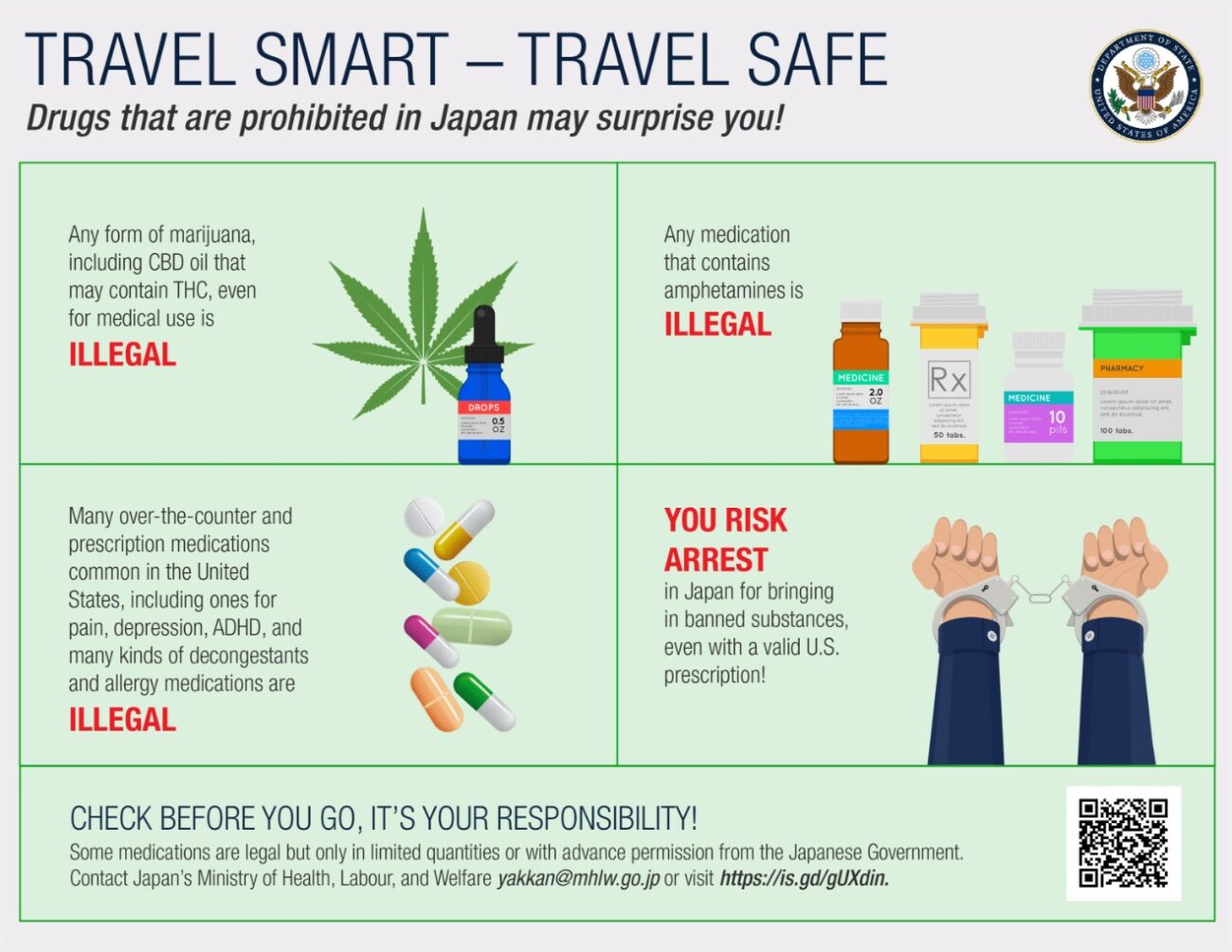
Image via the U.S. Embassy & Consulates in Japan
Once you arrive in Japan, you’ll go through all the same domestic responsibilities as people from other countries: get your residence card, my number card, and sign up for health insurance and pension. Sign up for utilities, phone, banking, and get your home base set-up.
Japanese residents are trained on natural disaster procedures and emergency scenarios since elementary school. Natural disasters are a fact of life here, and you should catch up to ensure you know how to stay as safe as possible when disaster strikes.
As this is a major topic on it’s own, we’ve already got a wildly comprehensive guide you should familiarize yourself with. Go read our article, The Granddaddy of All Japan Natural Disaster Planning Resource Guides to learn about the different kinds of disasters, how they impact location planning, and check out a risk map overlaying all risk factors.
Some basic points to know: earthquakes (and corresponding tsunami risk at coastal areas) are a unique risk to Japan, with experts predicting major, life-threatening quakes in the coming years. Tall and heavy furniture items need additional securing. You should study your evacuation map in advance, have emergency water and supplies on hand, and install emergency alert apps in English. Typhoons, flooding, volcanic eruptions, power plants, and heavy snowfall are also risks.
Technically, there are no unique Japanese requirements for Americans compared to people from other countries. But your obligations to the US are unique internationally.
The United States is one of only two countries in the world (the other being Eritrea) that taxes its citizens on worldwide income regardless of where they live. This means that even as a resident of Japan, you are still legally required to file a US federal tax return every year with the IRS.
The good news is that most Americans abroad won’t owe US taxes due to two key provisions:
If the total value of your foreign financial accounts exceeds $10,000 at any point during the year, you are required to file an FBAR (Foreign Bank Account Report), officially known as FinCEN Form 114, with the US Treasury Department. This is a separate filing from your tax return and is submitted electronically through the BSA E-Filing System. Penalties for non-filing can be severe, so don’t overlook this.
If your foreign financial assets exceed certain thresholds ($200,000 on the last day of the tax year, or $300,000 at any time during the year, for single filers living abroad), you’ll also need to file Form 8938 with your tax return under the Foreign Account Tax Compliance Act (FATCA). Note that this is in addition to, not instead of, the FBAR.
FATCA requirements add risk for Japanese banks, so some Japanese banks do not work with Americans (example: PayPay Bank).
Beyond taxes, there are a few other things worth maintaining from an American administrative standpoint:
The US Embassy in Japan maintains an extensive list of resources, including for daily life, domestic violence, Tokyo life, multicultural co-existence, counseling, specialists for children and family, medical assistance, legal, human rights, employment assistance, and more.
American military veterans: you have some unique considerations and potential advantages when it comes to moving to Japan, as well as some factors that may benefit from close planning in advance.
If you receive a US military pension or VA disability compensation, that income can help you secure a stable lifestyle in Japan. But it won’t get you a visa! You’ll still need to either run a business, get a job, or have a spouse who can sponsor you. If you can’t be sponsored by a spouse, is it possible to get a visa without “working?” Yes and no – there are ways to become more of a hands-off business manager through acquisition. But the responsibility and profitability for the business will ultimately land on your shoulders. Even with low-maintenance business ownership, you’ll still need to have enough management responsibilities that immigration deems your presence is necessary. Sound complicated? It kind of is, so talk to us for information more specific to your scenario.
This is an area of significant limitation. Most VA facilities are in the United States, with the closest. Veterans living in Japan typically cannot access VA medical care in-country. However:
Japan does not currently offer a dedicated retirement visa (unlike countries such as Portugal or Malaysia), meaning retirees must qualify under one of the existing visa categories. For veterans receiving a pension, the most practical routes are:
Retiring to Japan is feasible but requires the same visa groundwork as any other long-term stay. Many American retirees enter on a working or student visa to establish residency, then transition over time. It’s a good idea to map a path towards PR if your goal is to retire in Japan, so you can assess if it’s realistic and what steps you need to take.
Moving to Japan from the USA is absolutely possible, but it requires more planning and paperwork than relocating between most countries – especially as an American, given your unique tax and financial reporting obligations. The key is to treat the process strategically: nail down your visa pathway first, make a realistic budget, choose a location that fits your lifestyle, and start your administrative checklist early.
Japan rewards those who prepare thoughtfully. The country offers an extraordinary quality of life: excellent public safety, affordable healthcare, incredible food, efficient public transit, and a culture unlike anywhere else on Earth. For Americans willing to do the work to get there, it’s one of the most rewarding moves you can make.
Have questions or want to share your own experience moving to Japan from the US? Japan Remotely is here to help.

23 February, 2026