




5 May, 2026


We all have our own reasons why we aspire to live in Japan – maybe it’s a life-long interest in the culture, seeking a different perspective, or even just looking for a new challenge. But it’s a tough jump for those of us who have established careers back home. And unfortunately, the job market in Japan doesn’t have a reputation of career opportunity for international people.
If you are lucky, you might have the ability to work remotely, be it for an employer or via a business of your own invention. This is great! The biggest problem (funding your life) is solved! Whether it’s a remote job, freelancing, a portfolio career, and/or passive income, you’re financially stable. But what you don’t have yet is permission to live in Japan.
There are many visa types available, but fitting modern careers into Japanese immigration categories can be a bit like fitting a square block into a round hole. The landscape got even tighter in October 2025, when the Business Manager Visa (the pathway most often used by self-employed people) saw its capital requirements jump from ¥5 million to ¥30 million, along with a flurry of other new rules.
I live in Japan on an Highly Skilled Professional (HSP) visa and work with clients navigating these pathways every day. For someone trying to navigate a remote-friendly career from Japan, here’s my proven advice.
🔴 The Business Manager Visa: You’re running or starting a real business in Japan. See more below.
🔴 Employment through a local partner: A Japan-based partner handles your employment locally while you continue your existing work. See more below.
🔴 Spouse or dependent visa: Your spouse is Japanese or already holds a qualifying visa. This is an easy option; however, it has some restrictions. Read more: Can Foreign Spouses Work Remotely in Japan?
🔴 Digital Nomad visa: Six months maximum, no renewal, no path to residency. Fine for testing the waters. Not a proper long-term strategy.
🔴 Moonlighting: Get a local day job in Japan and continue your overseas business on the side. You’ll need a good accountant, a flexible Japanese employer, and the right permissions.
The two pathways that matter most for my clients are the Business Manager Visa and employment through a local partner. Let’s take a closer look at the pros and cons of both.
The BMV used to be the default for anyone self-employed who wanted to move to Japan. Changes in October 2025 raised the capital threshold to ¥30 million (roughly $200,000 USD), and immigration is already scrutinizing applications more closely across the board. On top of that, you’re now expected to support at least one other full-time employee and have in-house business Japanese language capacity. If your work already requires having an employee and you already possess solid Japanese skills, great! But for most small business entrepreneurs, solopreneurs and remote workers, this is an undue burden.
The honest question is the same for everyone: are you going to operate a full business in Japan? If yes, pursuit of a business manager visa may still be the right path. If you are an independent remote worker, it probably isn’t. Pairing your scenario with the intention of the visa is the key to a proper (and sustainable) long-term match.
So what is the intention behind the Business Manager visa?
It may seem like a straightforward case. You own a small business, you want to run it from Japan, and there’s a valid business case for doing so. At a minimum, your business can operate just as well from Japan as where you are now. Ideally, being in Japan improves its success.
With the new requirements, however, indie business owners and owner-operators will have a harder time. If you’re in the “I run a business from my laptop” scenario, meeting all the financial and logistical barriers of this visa is usually overkill. After all, why would a small online business need ¥30 million in the bank?
It’s clear that Japan wants medium-sized businesses that create jobs by default. For many small business owners, the BMV just isn’t the right fit anymore.
Remember, the intention of the Business Manager Visa is to attract foreign investment and create jobs domestically. This isn’t automatically correlated with employee relocation to Japan, but there are a few cases where remote employees may be a good match for the BMV.
If you’re willing to renegotiate your employment into a contractor relationship (where your current employer becomes one of your primary clients), you could potentially qualify for BMV as a business owner in Japan. This only makes sense if the contractor model is genuinely viable and if there’s a real business case for operating from Japan. It’s a bigger life change than most employees are looking for, but for the right person, it works. The capital, employee, and language requirements still hold.
There is one more structure that can effectively reorganize the employment structure of a remote employee, effectively placing you into a standard work visa in Japan. It also happens to be a fairly straight-forward visa path, but very underutilized.
Your foreign company (or your own business) contracts with a Japan-based partner for services related to your project or role. This is a business-to-business relationship: the foreign organization is engaging a local partner to support its operations in Japan.
That partner then hires you locally in Japan to continue contributing to the project. They handle payroll, social insurance, pension, income tax withholding, and visa sponsorship. They also provide local management and support to you as the employee.
This model is sometimes referred to as Employer of Record, or EOR.
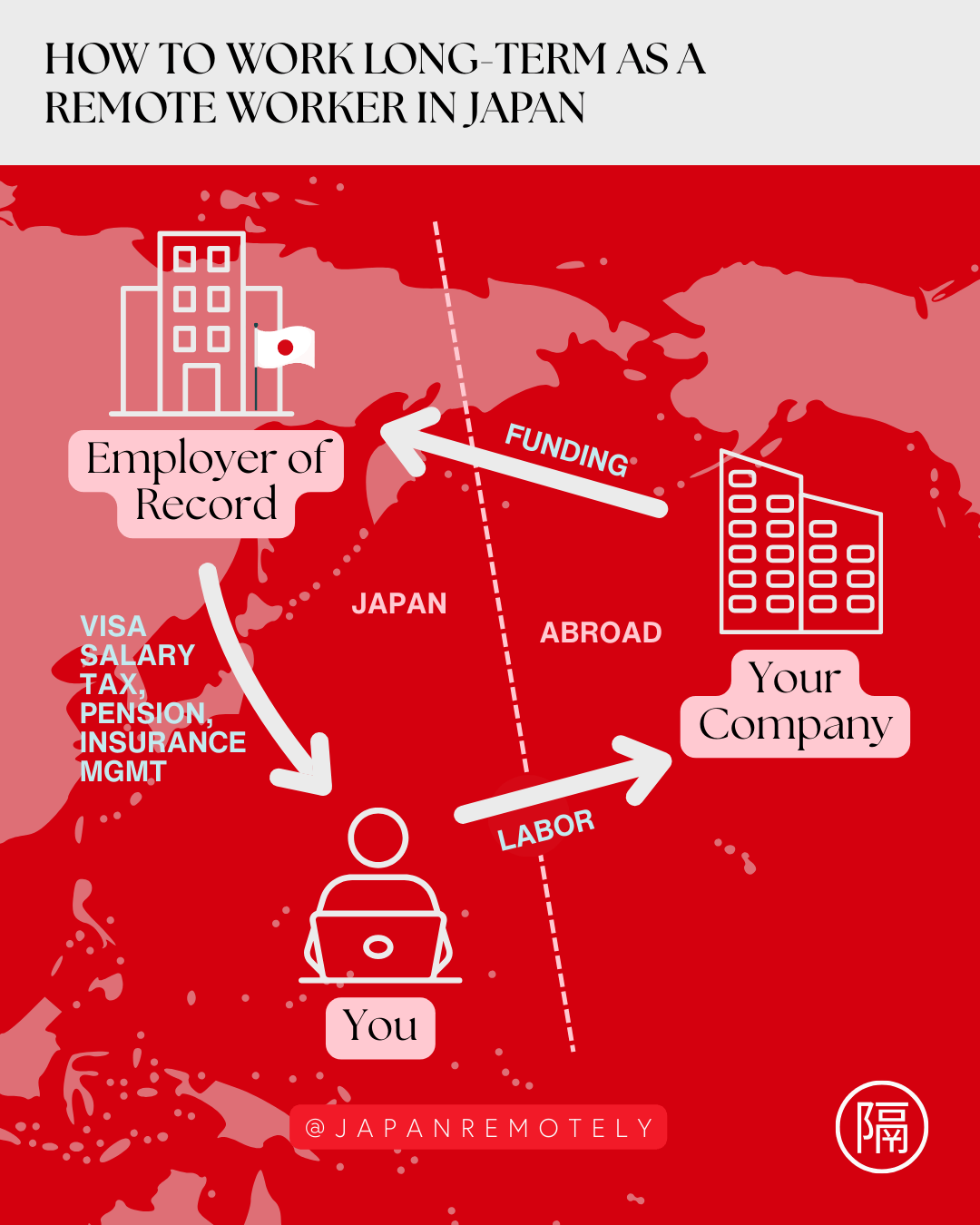
Who is this “partner” and where do you find them? The partner is a business. It might be purely an EOR business, or it could be an accounting, law, or business support company offering EOR services.
Opening a Japanese entity requires capital investment, a registered office, corporate bank accounts, and local accounting. Hiring an EOR is faster, simpler, and usually much cheaper. Most of the clients we’ve set up with an EOR are operational within two months.
You can facilitate a move as an employee in one of two ways – either your employer begins the process or you do.
If your employer directs the move, perhaps it’s because they need someone on the ground in Japan for business development, client relationships, APAC timezone coverage, or to support future expansion. Instead of opening a Japanese entity, they contract with a local partner who hires you.
If you initiate the process, it will require a bit more negotiation. You want to live in Japan, and you pitch your employer on why it makes business sense. The partner model makes that pitch a lot easier: it’s lower cost and lower commitment than opening an entity, with no long-term obligation if it doesn’t work out. Frame it around what you can do for the company from Japan, be it the APAC timezone coverage, access to Japan’s massive domestic market, in-person relationship building, and other ways your relocation will benefit them (not just because Japan is where you want to live).
In this scenario, your own company contracts with the local partner, and they hire you in Japan to continue working on the business. You’ll need a legitimate role, real compensation, and a business that makes sense with you operating from here. This is a practical alternative to then Business Manager Visa when your business doesn’t require a Japanese entity and you don’t want to commit ¥30 million in capital.
Some business owners use this while getting established. They take their time to build local relationships and revenue, and then transition to Business Manager Visa, spouse visa or permanent residency later as it makes sense. Some will stay on this path long-term because the overhead is lower and the hassle of compliance is taken off their plate. And EOR is a valuable service beyond opening the door to relocation.
Budget for salary, employer-side taxes and social insurance, and a monthly service fee to the partner. By our calculations, a minimum monthly budget that your organization would need to prepare for this partnership is ¥536,000. That covers all fees, taxes, and insurance, and leaves the employee with roughly ¥250,000 in net salary. Costs scale up from there depending on the role and compensation level. Compared to starting a Japanese entity, it’s significantly cheaper to launch and often cheaper to run.
There are also often initial fees and security deposits. The partner will need to do some work upfront to sponsor your visa, prepare your accounting and payroll, and maintain some buffer in case there’s a cash flow issue. The amount varies depending on the partner and the situation.
Employer of Record relationships do not support you in job placement. You must already have an employer, a client contract, or your own business with revenue. If you’re looking for a job in Japan, this isn’t the right pathway.
Additionally: as of March 2026, the Immigration Services Agency of Japan will require a pledge from both the EOR and the contracting organization stating that the working activities of the individual are aligned with the work visa classification. For example, if an individual enters Japan with an Engineer/Specialist in Humanities visa doing technical engineering desk work, they would not be able to accept local work as a construction worker, if that work were classified under the Specified Skilled Worker visa. (source)
What this means for you: an EOR visa is not a pass for unlimited lifestyle flexibility. You still need to do legitimate work within the business as described on your application.
If you’re a small business owner with the capital, you want to hire someone locally and you a genuine reason to operate in Japan, the Business Manager Visa still makes sense for you. If your business doesn’t need a Japanese entity, seriously consider employment through a local partner.
If you’re an employee and your company is willing to support a Japan move, then working with an Employer of Record is the fastest and simplest route. If you’d rather go independent and restructure as a contractor, the Business Manager Visa could still work, but it’s a bigger commitment.
Most of our clients have income, work, and want to live in Japan without starting a Japanese company. Here at Japan Remotely, we are happy to help you get started with a domestic partner.
We can help you plan your visa pathway, timeline, budget, location, and lifestyle aspirations in Japan. Reach out for a free consultation.
If you’re ready for an introduction to a trusted local employer partner, we can help with that, too. We will qualify your eligibility, review your options, and connect you with a local partner in Japan.
Best of all, initial calls and referrals are free. Reach out here!

5 May, 2026

10 November, 2025

19 September, 2025