





3 June, 2026


Dreams of moving to Japan are often followed by that pesky little question: what about the visa? And the default stand-by answer has been for a long time: you either need a job or a marriage (which, by the way, is not the whole picture. More details in our article, Best Ways to Move to Japan: Visa Advice from an Expert).
For those who don’t have marriage or entrepreneurial prospects, seeking a work visa will likely be your next best option.
But then the question is – is the Japanese workplace the right place for you?
Let’s take a look at what it means to really be a part of the workforce in Japan.
Working in Japan isn’t just a way to get a visa – it’s sometimes seen as a step towards true integration. As if in order to really prove one’s usefulness in the country, being a member of a Japanese company is the key.
And it’s true that immersion in a Japanese workplace will offer benefits besides the salary. For many, absorbing and practicing language skills via immersion would be a welcome challenge.
From glamorous tourism experiences to innovative tech start-ups, it seems that there are plenty of opportunities for legitimately rewarding work.
For those who have come here with a temporary English-teaching contract, transitioning out of a teaching job is seen as a desirable (though sometimes impossible) jump. And getting into the workforce is just the first obstacle.
For those who are able to make the leap, there are additional barriers to face. While school staff are used to the antics of freshly graduated foreign English teachers, Japanese companies are more likely to have little-to-no practice or accommodations in place to understand foreign workers.
The following workplace characteristics may be new to foreign employees:
Expectations are highly nuanced – check out this analysis of where to position yourself in business group scenarios from walking on the street to standing in an elevator.
But one of the largest frustrations I hear is less about learning keigo, wearing suits or long hours. It’s the lack of potential for career growth – also known as a “dead-end job.”
Hi! Are you planning your move to Japan? It’s stressful and confusing!
That’s why we made Japan Remotely Academy.
It’s years of hard-learned lessons, condensed into an easy-to-follow library of resources: how to get better jobs, find the best places to live, find foreigner-friendly housing and employment, and more! So you can move to Japan the best way for you (and the best way for Japan!) the first time around!
There are plenty of trustworthy employers in Japan, but it’s worth mentioning one of the worst situations a foreigner can encounter: the so-called Black Companies that should be avoided at all costs.
Black Companies are generally characterized by:
While the Ministry of Health, Labor and Welfare publishes a list of companies that have violated labor standards laws, there are likely several times more Black Companies that haven’t made it on the list. Why? First, many people do not report violations for fear of backlash or a belief that reporting will cause more harm than good. Second, legitimate violations cannot be filed if the employee’s working contract is not fully executed/valid.
You can cross reference company reputations on Openwork, Jobtalk.jp, Engage, and CareerConnection.jp. It’s better to avoid these companies from the start, especially if quitting will put your visa status at risk.
But a much more likely scenario is that you will end up working in Japan with a fine company that has… sub-par ability to work with foreigners.

Homogeneity in the workplace has been seen as a strength for a long time, however the decreasing workforce and pressures to globalize have put corporate Japan head-to-head with a new challenge: DEI. And while diversity, equity and inclusion efforts are common topics in America, these are new ideas in Japan.
DEI conversations are generally not in regard to foreign workers, but rather Japan’s female workforce and Japanese LGBTQ+ people. I have to admit, it was a bit confusing at first why Japanese DEI focuses on the promotion of women. After all, women make up about 50% of the population here. Women are not a minority…
The thing is, women are not supported in professional environments. Japan continues to be a place where women are passed over for promotion and asked at interviews when they are planning to get pregnant.
Unfortunately for the progressive workplaces that make the leap with a foreign hire, it can sometimes be a superficial step towards diversity, but little to no understanding (and therefore no actionable steps) towards equity or inclusion.
The burden is likely to be carried by the “diverse hire,” to both navigate and negotiate for their own needs.
Recommended: Key Factors To Achieving Diversity, Equity And Inclusion In Japan
Prejudice in Japan is a deep topic with quite a wide range of stories to be heard. On one end, there are Japanese people who are in-tune with international happenings, who can relate with international people nearly seamlessly. On the other end, there are Japanese people who see anything non-Japanese as impure and inferior, or those who are so fascinated by foreign people that it gets, well… weird.
The most common hurdles will not necessarily be because some is foreign, but because they are not Japanese. It’s a careful distinction. Much can be done to smooth over the differences (improving language, being mindful of expectations, trying to fit in goes a long way). But even many Japan-born people of obvious foreign ancestry struggle to be treated like an insider.
“No matter how long a non-Japanese works for a Japanese company, he or she is still considered an outsider. It’s a black-and-white issue with nothing in between.” [source: Harvard Business Review]
One of the best ways to navigate corporate Japan and land in a supportive environment will likely be through personal networking. Having a base of foreign professionals is invaluable, and can be built through LinkedIn or in-person events such as through Meetup or FEW.
And it’s also worth noting that gradually, things keep getting better.
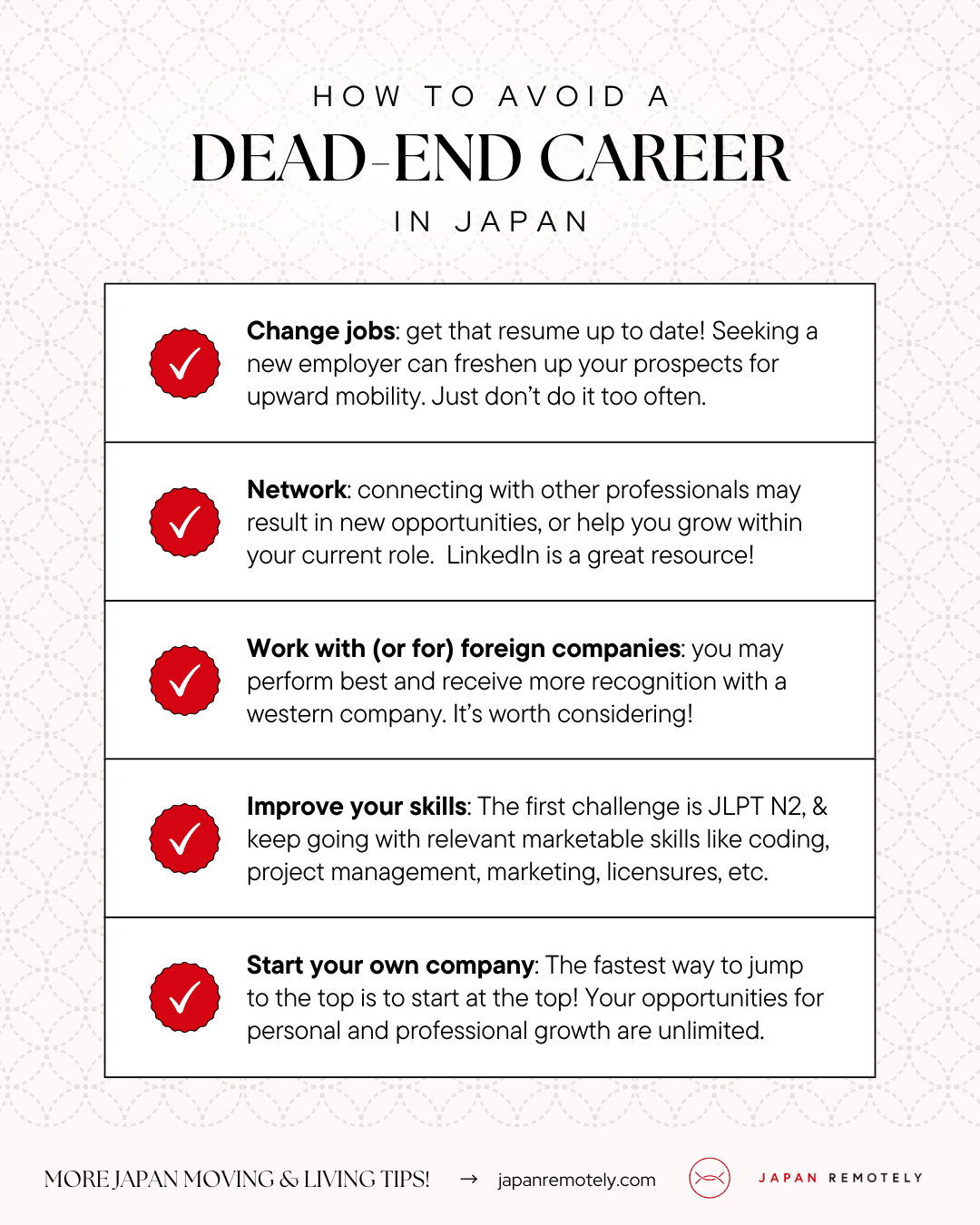
Quite often, yes!
It’s very difficult for foreigners to advance their careers at traditional Japanese companies. It takes a combination of Japanese language mastery, networking, cross-cultural business fluency, marketable skills, patience, and above all, luck.
For those with marketable skills in tech, there has been a push from Japanese companies to attract foreign developers by offering better salaries and work conditions to the right candidates. TokyoDev is one of the best hubs for foreign developers and Japanese companies to connect.
If you are planning ahead for your jump to Japan, we recommend consider alternative career paths when it comes to making your income.
Getting a regular job, however, is a tried and true method to getting a visa. No disrespect to those that do it! Just don’t lose sight of what you really want to do. Be prepared to make a pivot when the time is right.
There will be a whole new set of challenges to look out for. The benefits may not be parallel to benefits expected from a western workplace. For example, individual recognition and esteem will likely be replaced by group focus. And traditional promotions might be hard to come by.
But for as many challenges as there are, there are just as many opportunities. Sometimes they won’t be so obvious, and there will be a lot of effort you need to do to advocate for your own growth. But nothing can replace the experience and skills gained by mastering cross-cultural business fluency.
Need a sounding board to help with your Japan immigration strategy? We’ve got your back!
👋 Hi! I’m Nick, an experienced Immigration and Moving Consultant at Japan Remotely. We help navigate visa types, Japan real estate, location scouting, career opportunities in Japan, business strategy, and more. We help you create a realistic Action Plan and Visa Strategy, so you can find your fastest track to permanent residency and the lifestyle you’ve been dreaming of.
Interested to learn more? Talk to us! We are happy to discuss a custom strategy.

23 February, 2026